NEWSTIVI
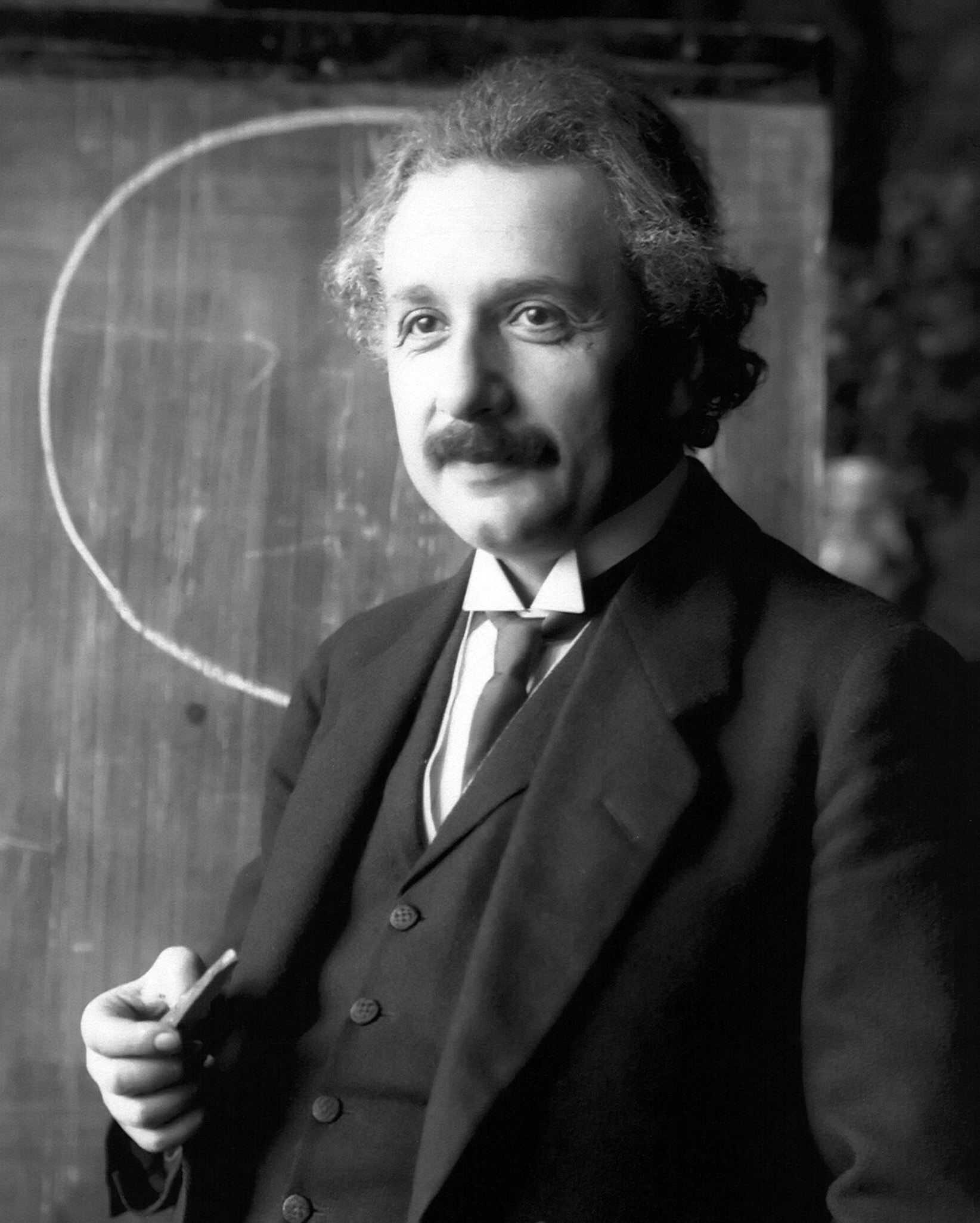
Albert Einstein
Theoretical physicist
1879-03-14 — 1955-04-18
Albert Einstein (1879–1955) was a German-born theoretical physicist whose work on relativity, light and quantum theory transformed modern physics.
EARLY LIFE AND EDUCATION
Albert Einstein was born on March 14, 1879, in Ulm, Germany, into a Jewish family. He developed an early interest in mathematics and physics. After continuing his education in Switzerland, he graduated from the Swiss Federal Polytechnic in Zurich in 1900.
Unable to obtain an academic position immediately, Einstein worked as a patent examiner in Bern. He continued investigating fundamental problems in physics alongside his employment. In 1905, he received a doctorate from the University of Zurich.
THE BREAKTHROUGHS OF 1905
During 1905, often called his “miracle year,” Einstein published four papers that transformed physics. His work addressed the photoelectric effect, Brownian motion, special relativity, and the relationship between mass and energy.
His analysis of Brownian motion strengthened the case for the existence of atoms and molecules. His work on light proposed that energy could be exchanged in discrete packets, helping establish the foundations of quantum physics. Special relativity changed the understanding of space and time, while the equation E = mc² expressed the equivalence of mass and energy.
GENERAL RELATIVITY
Einstein continued developing his ideas while holding academic and research positions in Europe. In 1915, he completed general relativity, a theory that described gravitation in terms of the geometry of spacetime.
The theory predicted that gravity would bend light. Observations of starlight during the 1919 solar eclipse supported this prediction and helped make Einstein internationally famous. His work opened new ways to investigate gravity and the universe.
THE NOBEL PRIZE
Einstein received the 1921 Nobel Prize in Physics, which was awarded to him in 1922. The award recognized his contributions to theoretical physics, especially his discovery of the law of the photoelectric effect. It was not specifically awarded for relativity. His explanation of the photoelectric effect became an important part of the development of quantum theory.
LIFE IN THE UNITED STATES
In 1933, Einstein settled in the United States rather than return to Germany under Nazi rule. He joined the Institute for Advanced Study in Princeton, New Jersey, where he remained a faculty member until his death. He became an American citizen in 1940.
In 1939, he signed a letter to President Franklin D. Roosevelt warning that nuclear weapons might be possible and that Germany could attempt to develop them. Although the letter influenced early American interest in uranium research, Einstein did not work on the Manhattan Project or design the atomic bomb.
LATER YEARS AND LEGACY
Einstein spent much of his later scientific career seeking a unified description of physical forces. He also spoke about peace, civil liberties and nuclear disarmament.
He died on April 18, 1955, in Princeton, aged 76. His research reshaped the understanding of light, matter, space, time and gravity. His scientific papers and correspondence continue to be studied through projects such as the Einstein Papers Project, which documents both his intellectual achievements and his life in their historical context.
Sources
Nobel Prize — Albert Einstein: Facts
https://www.nobelprize.org/prizes/physics/1921/einstein/facts/
Institute for Advanced Study — Albert Einstein: In Brief
https://www.ias.edu/albert-einstein-brief
Institute for Advanced Study — Albert Einstein
https://www.ias.edu/scholars/einstein
Caltech Einstein Papers Project — The Swiss Years, Volume 2
https://www.einstein.caltech.edu/what-we-do/published-volumes/volume-2
U.S. National Park Service — Albert Einstein
https://www.nps.gov/people/manhattan-project-pioneers-albert-einstein.htm
Portrait: Ferdinand Schmutzer, Vienna, 1921; Wikimedia Commons, public domain.
https://commons.wikimedia.org/wiki/File:Einstein_1921_portrait2.jpg