NEWSTIVI
Nikola Tesla
Inventor and electrical engineer
1856-07-10 — 1943-01-07
Nikola Tesla (1856–1943) was an inventor and electrical engineer known for his contributions to alternating-current motors and polyphase electrical power systems.
EARLY LIFE AND CAREER
Nikola Tesla was born on July 10, 1856, in Smiljan, then part of the Austrian Empire and now in Croatia. His father, Milutin Tesla, was a Serbian Orthodox priest; his mother was Đuka Mandić. His interest in electrical and mechanical devices became the focus of his working life.
Tesla gained practical experience in Europe, working in telegraphy and electrical engineering, including positions in Budapest and Strasbourg. In 1884, he moved to the United States and joined Edison Machine Works in New York. He subsequently pursued independent research.
ALTERNATING CURRENT AND THE INDUCTION MOTOR
One of Tesla’s most important contributions was an alternating-current induction motor that used a rotating magnetic field. His work on polyphase alternating-current systems helped advance the generation, transmission and use of electrical power.
Tesla did not invent alternating current itself. Other researchers had investigated it before him. His achievement lay in developing practical motors and related systems based on rotating magnetic fields and polyphase currents. His 1888 agreement with George Westinghouse helped bring these technologies into wider use. His work also contributed to the adoption of alternating-current power at Niagara Falls.
THE TESLA COIL AND WIRELESS EXPERIMENTS
In 1891, Tesla developed the Tesla coil, a circuit capable of producing high-voltage, high-frequency electricity. He used such equipment to investigate electrical oscillations and wireless energy transmission.
Wireless communication was another important area of his research. In 1898, he demonstrated a small radio-controlled boat at Madison Square Garden in New York. It was an early, striking demonstration of remote control.
THE WARDENCLYFFE PROJECT
Following his experiments in Colorado Springs in 1899, Tesla turned to the Wardenclyffe facility on Long Island. Developed between 1901 and 1905, the project aimed to support global wireless communication and explore the broader transmission of electrical power without wires.
The project’s ambitions exceeded its financial resources. Wardenclyffe was never completed as planned, and its tower was demolished in 1917. It should not be described as a successfully established system that supplied unlimited energy to the world: the project did not achieve that outcome.
LATER YEARS AND LEGACY
Tesla died on January 7, 1943, at the New Yorker Hotel in New York City. He obtained numerous patents during his lifetime and secured a lasting place in engineering history, particularly through his work on electric motors and alternating-current systems.
His work can be studied through the archives of the Nikola Tesla Museum in Belgrade and the collections of scientific institutions. His life illustrates how successful inventions, experimental setbacks, technical limitations and access to funding all shape the history of science and technology.
Sources
National Inventors Hall of Fame — Nikola Tesla
https://www.invent.org/inductees/nikola-tesla
Nikola Tesla Museum — Life and Work
https://tesla-museum.org/en/nikola-tesla-2/life-and-work/
Nikola Tesla Museum — Family Background
https://artsandculture.google.com/story/nikola-tesla-museum-museums-of-serbia/SAXRM4wd1FGDPA?hl=en
Tesla Science Center — Nikola Tesla Inventions
https://teslasciencecenter.org/nikola-tesla-inventions/
Tesla Science Center — The Wardenclyffe Tower
https://teslasciencecenter.org/history/tower/
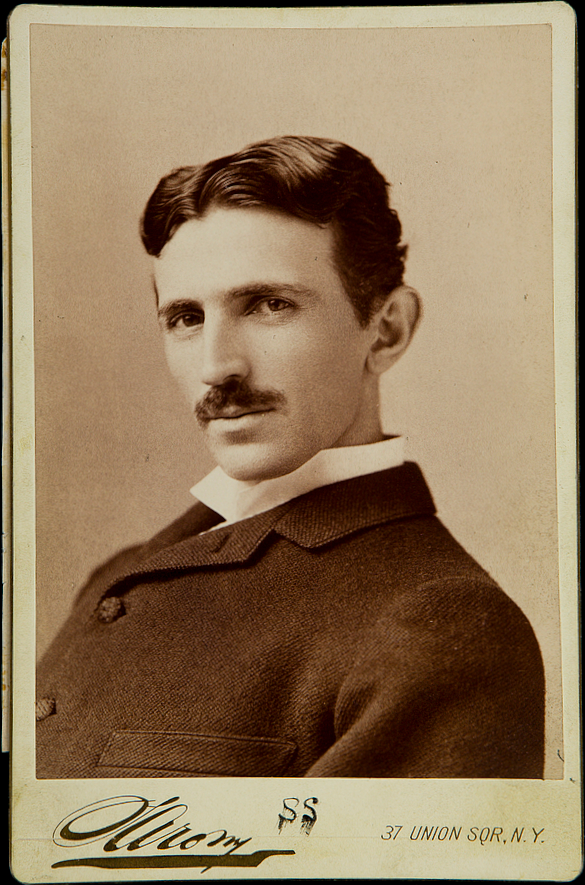
Portrait: Napoleon Sarony, approximately 1890–1896; Harvard collection / Wikimedia Commons, public domain.
https://commons.wikimedia.org/wiki/File:Nikola_Tesla_by_Sarony_c1893.jpg