NEWSTIVI
Rosalind Franklin
Chemist and X-ray crystallographer
1920-07-25 — 1958-04-16
Rosalind Franklin (1920–1958) was an English chemist and X-ray crystallographer whose research was crucial to understanding DNA’s structure. She also made important contributions to the study of coal, graphite and viruses.
EARLY LIFE AND EDUCATION
Rosalind Elsie Franklin was born on July 25, 1920, in London, England. She developed an early interest in science and attended St Paul’s Girls’ School before studying natural sciences, with a focus on chemistry, at Newnham College, Cambridge, from 1938 to 1941.
During the Second World War, she joined the British Coal Utilisation Research Association. Her investigations of coal and related carbon materials formed the basis of the doctorate awarded to her by Cambridge in 1945.
COAL, CARBON AND X-RAY METHODS
Franklin’s early research examined how the internal structure of coal affected its properties. This work had practical importance for understanding fuels and other industrial uses of carbon.
After the war, she worked in Paris with Jacques Mering, developing expertise in X-ray diffraction. The technique uses patterns produced when X-rays scatter from a specimen to investigate its structure. Her work on coal and graphite established her reputation before she began studying DNA.
DNA RESEARCH AT KING’S COLLEGE LONDON
Franklin joined King’s College London in 1951. Working with doctoral student Raymond Gosling, she improved experimental methods for studying DNA fibres and investigated how their diffraction patterns changed with water content. This helped distinguish the A and B forms of DNA.
In May 1952, their experiments produced Photograph 51, a particularly clear diffraction pattern of the B form. Its characteristic cross-shaped arrangement provided important evidence of a helical structure. The image was an experimental diffraction pattern, rather than a conventional photograph showing a DNA molecule directly.
PHOTOGRAPH 51 AND THE DOUBLE HELIX
Franklin’s measurements and analysis were essential contributions to understanding DNA’s structure. Maurice Wilkins showed Photograph 51 to James Watson without Franklin’s knowledge. The photograph and other results from King’s helped Watson and Francis Crick develop their double-helix model.
Franklin and Gosling published their own experimental paper in Nature on April 25, 1953, alongside the papers by Watson and Crick and by Wilkins and colleagues. Her contribution involved careful preparation, measurement and interpretation, extending well beyond the production of one famous image.
VIRUS RESEARCH AT BIRKBECK
In 1953, Franklin moved to Birkbeck College, London, where she built a research group investigating viruses. Working with colleagues including Aaron Klug, she studied tobacco mosaic virus and the arrangement of its RNA and protein components.
These investigations helped establish structural virology as an important field. Her later career demonstrates the breadth of her scientific interests and her ability to apply physical methods to biological questions.
DEATH AND LEGACY
Franklin died in London on April 16, 1958, aged 37. In 1962, Watson, Crick and Wilkins received the Nobel Prize in Physiology or Medicine for their work on nucleic acids; Franklin had already died and received no Nobel Prize.
Her research is now widely recognised as fundamental to the history of molecular biology. Her broader legacy includes influential work on carbon materials and viruses, rigorous experimental practice, and continuing discussion about recognition and the sharing of scientific results.
Sources
King’s College London — Rosalind Franklin
https://www.kcl.ac.uk/people/rosalind-franklin
King’s College London — The story behind Photograph 51
https://www.kcl.ac.uk/the-story-behind-photograph-51
Rosalind Franklin Institute — Rosalind Franklin’s Life
https://www.rfi.ac.uk/discover-learn/rosalind-franklins-life/
International Union of Crystallography — Rosalind Franklin 1920–1958
https://journals.iucr.org/d/issues/2020/07/00/me6088/
King’s College London Archives — Contributing to the story of life (2008)
https://www.kcl.ac.uk/archive/publications/comment-archive/pdfs/2008/comment-180.pdf
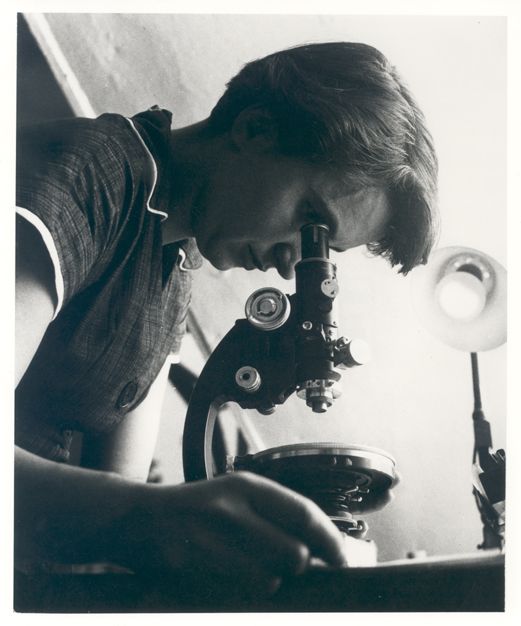
Portrait: MRC Laboratory of Molecular Biology, 1955; from the personal collection of Jenifer Glynn, via Wikimedia Commons. Original image used without file modifications; displayed to fit the page.
https://commons.wikimedia.org/wiki/File:Rosalind_Franklin.jpg
Image license: Creative Commons Attribution-ShareAlike 4.0 International (CC BY-SA 4.0).
https://creativecommons.org/licenses/by-sa/4.0/