NEWSTIVI
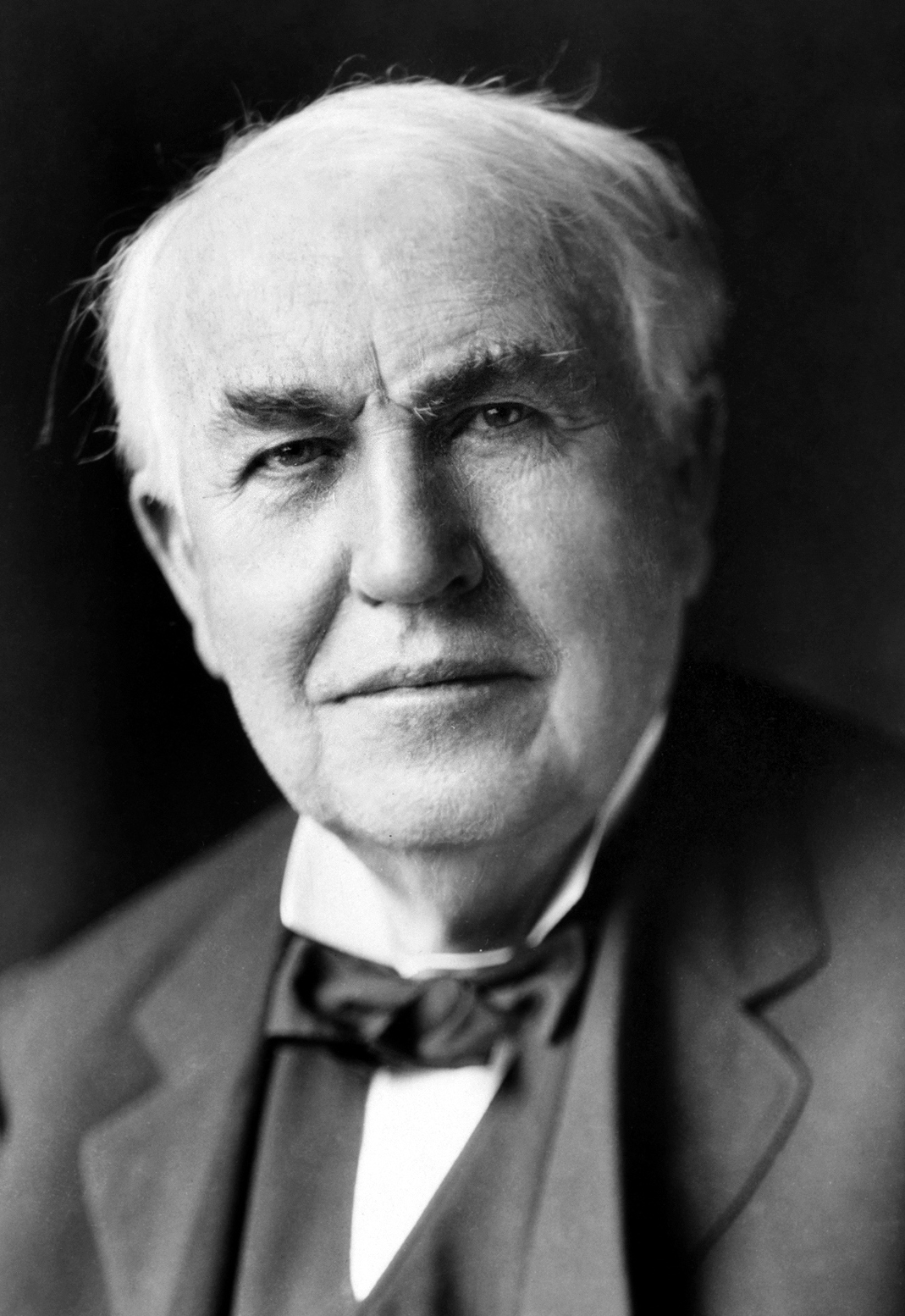
Thomas Edison
Inventor and businessman
1847-02-11 — 1931-10-18
Thomas Edison (1847–1931) was an American inventor and businessman whose laboratories helped develop sound recording, practical electric lighting and early motion pictures. His career combined experimentation, collaborative research and industrial production.
EARLY LIFE AND TELEGRAPHY
Thomas Alva Edison was born on February 11, 1847, in Milan, Ohio, in the United States. His family later moved to Port Huron, Michigan. He received much of his early education at home and developed a strong interest in reading, experiments and mechanical devices.
As a young man, Edison sold newspapers on trains and learned telegraphy. Working as a telegraph operator exposed him to electrical instruments and the practical demands of communication networks. Improvements to telegraph equipment helped establish his career as an inventor and businessman.
MENLO PARK AND COLLABORATIVE INVENTION
In 1876, Edison established a laboratory at Menlo Park, New Jersey. He brought together experimenters, machinists and other skilled workers to develop and test ideas. This organized approach joined research with manufacturing and commercial development.
Although his name became famous, his achievements depended on collaborators and on a wider community of inventors. His laboratories helped make teamwork and repeated experimentation central to industrial innovation.
THE PHONOGRAPH
In 1877, Edison developed the phonograph, a machine capable of recording and reproducing sound. The invention brought him international attention and the nickname Wizard of Menlo Park.
Earlier work by Édouard-Léon Scott de Martinville had already recorded sound visually. Edison’s important achievement was a device that could also play a recording back. He continued developing phonographs and recording technology over many years, helping establish a new entertainment industry.
ELECTRIC LIGHT AND POWER
Edison did not invent electric lighting from nothing. Other experimenters had already produced electric lamps. His team’s contribution was to develop a practical incandescent lighting system, combining improved lamps with generators, wiring and equipment for supplying electricity.
The lighting system was demonstrated at Menlo Park in December 1879. In September 1882, the Pearl Street station in lower Manhattan began supplying electric light and power to customers. These projects helped turn laboratory development into an urban electricity service.
MOTION PICTURES AND LATER WORK
Edison opened a larger laboratory complex in West Orange, New Jersey, in 1887. Its work included improved phonographs, motion pictures and storage batteries. William Kennedy Laurie Dickson and other collaborators played major roles in the development of the Edison motion-picture camera and viewing equipment.
Not every venture succeeded. Edison’s investment in iron-ore processing brought substantial losses, while his alkaline storage battery found useful industrial applications. His career combined technical invention with manufacturing, financing and business risk.
DEATH AND LEGACY
Edison died at his home in West Orange on October 18, 1931, aged 84. He received 1,093 United States patents during his lifetime.
His legacy includes influential work in sound recording, electric lighting and early cinema. Equally significant was his way of organizing laboratories, skilled teams and businesses to carry inventions from experiments into everyday use.
Sources
National Park Service — Edison Biography
https://www.nps.gov/edis/learn/historyculture/edison-biography.htm
Rutgers University, Thomas A. Edison Papers — Detailed Biography
https://edison.rutgers.edu/life-of-edison/biography/detailed-biography
National Park Service — The Origins of Sound Recording
https://www.nps.gov/edis/learn/historyculture/origins-of-sound-recording.htm
National Park Service — Origins of Sound Recording: The Inventors
https://www.nps.gov/edis/learn/historyculture/origins-of-sound-recording-the-inventors.htm
Portrait: Louis Bachrach, circa 1922; restoration by Michel Vuijlsteke; Wikimedia Commons, public domain in the United States.
https://commons.wikimedia.org/wiki/File:Thomas_Edison2-crop.jpg